Most men think about how to choose a wedding ring for about fifteen minutes. They look at three websites, click on whichever ring catches their eye, and order. Then they wear it for the next forty years.
This is one of the few decisions in a man's life where fifteen minutes of thought has to outlast almost every other thing he buys. The car will be gone in a decade. The house in two. Most of his clothes will be replaced multiple times. The wedding ring stays. Worth more than fifteen minutes.
Five questions to ask before you click. They're simple, but they catch the things most men only realize they should have thought about ten years in.
Question 1 — Will it look right at fifty?
This is the question that separates the men who still love their wedding ring at fifty from the men who quietly replaced it in their forties. The answer is rarely about the ring itself — it's about the design language.
Look at any men's wedding band from the 1950s. Then look at one from the 1980s. Then 2000s. The 1950s rings — clean profiles, modest widths, restrained finishes — still look right today. The 1980s rings — wider, fashion-finished, occasionally pressure-set with stones — look unmistakably 1980s. The 2000s rings show their decade too.
The rings that survive don't follow the era's loudest aesthetic. They take the version that's already been around for fifty years and look like it'll keep being around. Brushed or satin finishes. Balanced proportions. No statement details. The kind of ring you couldn't pin to a specific year if someone showed you only the metal.
If you're standing in front of a ring you love right now, ask one question: does this look like the ring of a particular moment, or does it look like a ring from any moment? The first kind dates. The second kind doesn't.
Question 2 — What does my hand actually do?
The honest answer is usually 'more than I think.' Most men underestimate the daily impact on their wedding ring — typing, gripping, washing, the small impacts that accumulate.
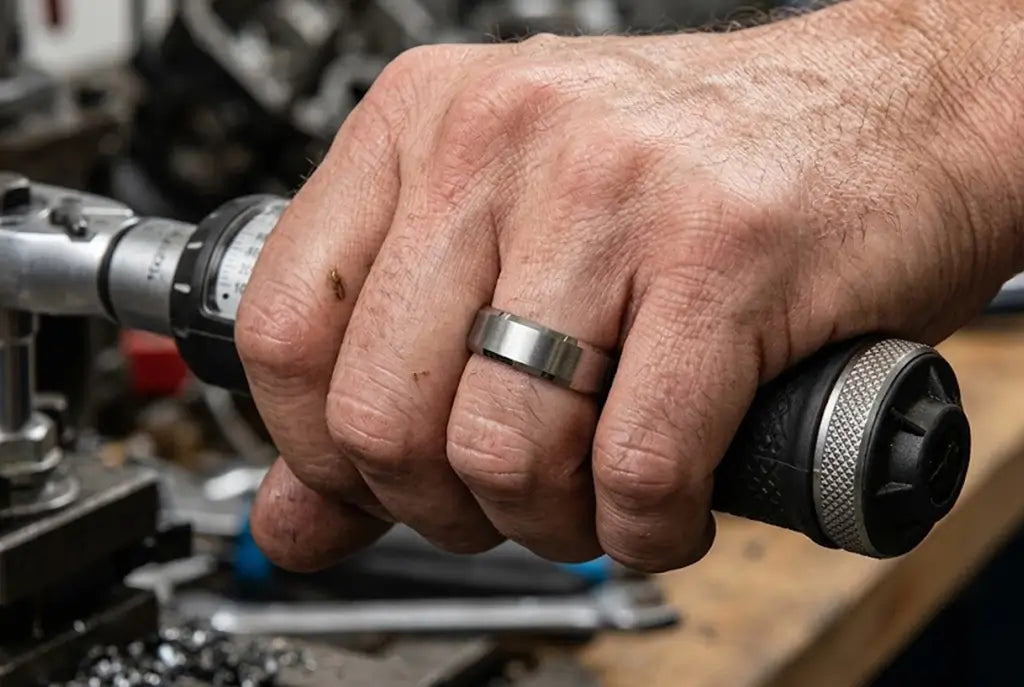
If your hands are mostly desk-based, gold and platinum work fine. They'll soften over years, but the wear pattern is gentle. If your hands are hands-on — work, hobbies, sports, kids, kitchen, garage — the math changes. Soft metals show every year. Hard metals (tungsten, ceramic, harder titanium) hold their finish through wear that would mark gold visibly.
Two specifics that matter:
Hand size. A larger hand wears wider proportions better; smaller hands lean narrower. We covered this in detail elsewhere — but it bears mentioning here because the wrong width on the wrong hand is one of the most common reasons men quietly stop wearing their ring after a few years.
Finger fluctuation. Fingers swell with heat, weight gain, exercise, age. Most men's ring fingers grow half a size or more between thirty and sixty. A ring sized perfectly today should still fit reasonably loosely on a hot summer afternoon at fifty-five — or you'll find yourself not wearing it on those days, and 'not wearing it' has a way of becoming permanent.

Question 3 — Can I afford the ring's failure mode?
Every metal has a failure mode. Gold and platinum bend, dent, and accumulate scratches. Tungsten can crack under sharp impact. Titanium resists most things but is hard to remove in an emergency. Silicone tears.
The question isn't which metal fails — they all do, in their own way. The question is whether the failure mode is one you can absorb.
A $1,200 platinum band that gets dented on a job site is psychologically painful — even if it's still wearable, even if it's still valuable, the wearer notices the damage every time they look at it. A $179 tungsten band that cracks is replaceable through a lifetime warranty for a small fee. The wearer mourns it for a day and moves on.
Pick the metal whose failure mode you can live with. For men who do hands-on work, tungsten's combination of high resistance to gradual wear and replaceability under warranty is usually the lowest-stress answer. For men whose work is gentle on jewelry but who care deeply about the metal itself, gold or platinum's gradual aging is its own appeal.
Question 4 — Does it look right next to a watch I've owned for ten years?
This is the test no one will tell you about, and it's the best one we know.
Find a piece of menswear you've owned for at least five years and still love. Could be a watch, a wallet, a leather bag, a pair of shoes, a knife. Something that's been with you long enough to be part of your daily life. Look at it. Notice what you respond to.
The men's objects that age well share characteristics. Restrained finishes that take wear gracefully. Materials chosen for character rather than novelty. Designs that don't try too hard. A confident kind of plainness.
Now look at the ring you're considering. Does it belong in that company? If yes — if you can imagine it sitting on the dresser next to the watch, the wallet, the knife — it's probably the right ring. If it feels like it doesn't quite fit with the long-running objects in your life, it's probably not.
This sounds soft, but it's actually the most reliable test we know. The men who choose wedding rings that match their other long-running possessions almost never replace them. The men who pick a ring that feels different from the rest of their life — louder, more decorative, more 'wedding-ring-y' — replace at higher rates.
Question 5 — Will I want my son to wear this?
Not literally — most sons end up choosing their own. But the question is a useful filter.
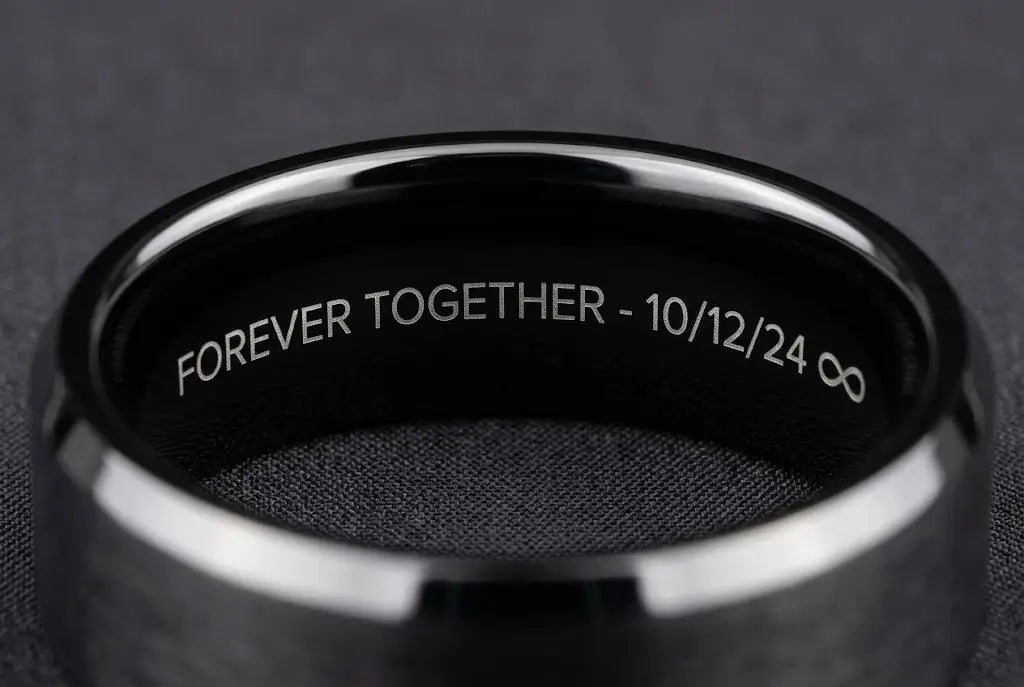
If you imagine handing this ring to your son when he's getting married, with the engraving on the inside ('To [your name], from [your wife], 2026'), would you feel pride or vague embarrassment? Would the ring still mean something in 2056?
The rings that pass that test tend to be modest, well-made, and built around materials that have track records — tungsten, gold, platinum, real meteorite, real wood. The rings that fail it tend to be novelty rings that, in retrospect, feel of-their-moment in a way that doesn't survive the moment.
This is what 'modern heirloom' actually means as a design constraint. A ring that's worth handing down isn't an antique. It's a contemporary object built to constraints that have always defined heirloom-quality work — restraint, durability, and a kind of timelessness that comes from refusing to chase trends.
If you can only do one thing
If you have fifteen minutes instead of an hour, do this: open up the photos on your phone of your father, your grandfather, or any older man whose presence you respect. Find a photo where his hand is visible. Look at the ring.
It's almost certainly a plain, restrained band. Not because old men have boring taste — because the rings that survive forty years on a hand are the ones that didn't try to do too much. The flashy ones got replaced. The plain ones got worn.
Choose accordingly.
Frequently Asked Questions
How do I choose a wedding ring I won't regret in 20 years?
Five questions filter most regrets. Will it look right at fifty? What does my hand actually do daily? Can I afford the ring's failure mode? Does it look right next to a watch I've owned for ten years? Will I be glad to hand it down? Rings that pass all five tests tend to be restrained, well-made, and built from materials with track records — gold, platinum, tungsten.
What's the most timeless men's wedding band style?
A simple, smooth-profile band in a restrained finish — brushed, satin, or polished — without inlays or statement details. The proportions and finishes that defined men's wedding bands in the 1950s still read as right today. The ones that defined 1980s and 1990s wedding bands often don't. Restraint ages better than fashion.
Should I match my wedding ring to my watch?
Not literally, but yes in spirit. The visual register of a good watch — restrained, well-proportioned, finished for daily wear — is the same register that ages well in a wedding band. A ring that belongs in the same drawer as your favorite watch tends to be the ring you'll still want to be wearing in twenty years.
How much should I spend on a men's wedding band?
Enough that the construction quality is real, not so much that the inevitable wear feels catastrophic. For tungsten, that's typically $149–$299. For gold, $600–$1,500. For platinum, $1,200 and up. The wrong answer is the cheapest tier, where the construction often won't survive a decade of daily wear. The other wrong answer is overpaying for retail markup, where you're paying for the store, not the ring.
Will my taste in wedding rings change as I age?
Yes — and the change has a direction. Most men's taste shifts toward more restrained, more functional, less decorative as they age. The ring that feels right at fifty is almost always more understated than the ring that felt right at twenty-five. Choosing for the older version of yourself, not the younger one, is the closest thing to a universal rule we know.