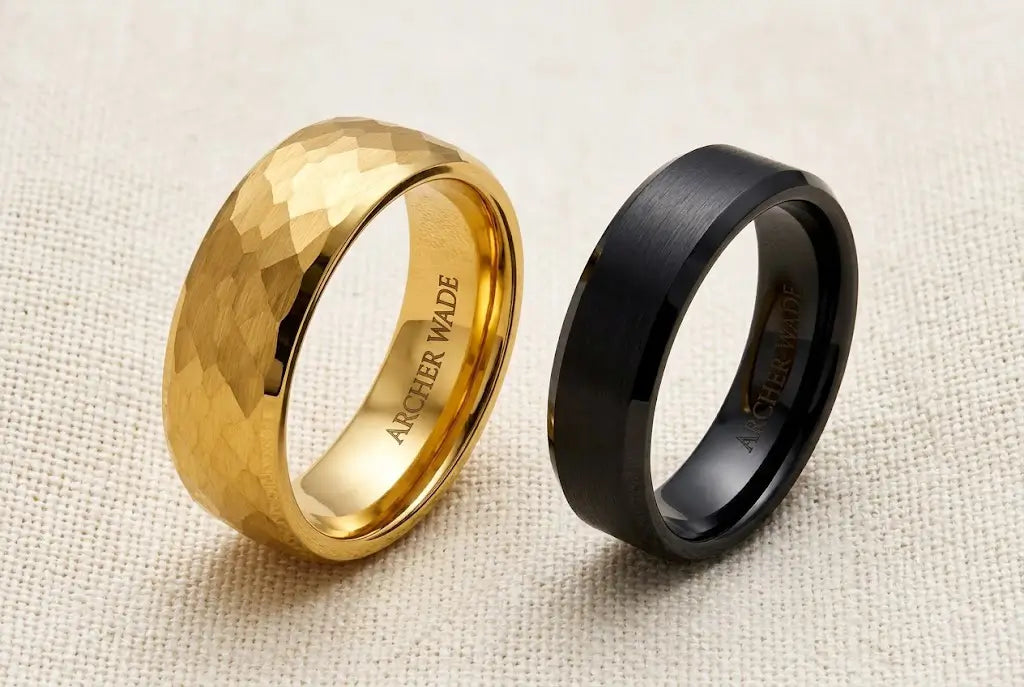
Why heirloom quality matters in a wedding band comes down to a fact most men don't think about at the the day you chose it: a wedding band is one of the few objects a man will physically wear, every day, for the rest of his life. Forty years on his hand. The ring will outlast almost every other object he owns.
Forty-five years, fifty, longer. On his hand for every meeting, every flight, every meal, every photograph of every birthday and reunion and ordinary Tuesday. Most men don't think about it that way at the day you chose it. But the ring will outlast almost every other object he owns. The car, the laptop, the suit, the shoes — gone, replaced, gone again. The ring stays.
Once you see the ring that way — as the long-running constant rather than the wedding-day prop — the question of quality starts to mean something different. It's not about the moment. It's about the next four decades of moments.
What Heirloom Quality Actually Requires in a Wedding Band
The word "heirloom" is overused in jewelry marketing. Most of the time it means nothing — a flourish to justify a price tag. So it's worth defining what an heirloom-quality wedding band has to do, structurally, to earn the term.
It has to age well. Materials matter — wood, meteorite, tungsten carbide, real gold and platinum. These metals and inlays have track records measured in centuries or longer. They don't tarnish into something unrecognizable. They settle into themselves.
It has to be designed against trends, not toward them. Aggressive widths, fashion finishes, statement profiles — these date faster than the metal under them. The design choices most likely to look right in 2055 are the same ones that have looked right since the 1950s. Balanced proportions. Restrained finishes. A profile that doesn't fight the hand.
It has to be built to last. Comfort-fit interiors. Scratch-resistant surfaces. A construction process that doesn't introduce weak points. And a warranty long enough to mean something — lifetime, ideally, with serial-number traceability.
Brands that hit those three marks are the ones whose rings end up on the next generation's hand. Brands that hit two, or one, or none, produce rings that get replaced inside a decade. This is why heirloom quality matters in a wedding band more than almost any other piece of jewelry a man will ever own.

Why a Men's Wedding Band to Pass Down Has to Outlast the Decade
Walk into any antique shop and you'll see the same pattern. Wedding bands from the 1940s and earlier — gold, platinum, simple profiles — are everywhere. Bands from the 1980s and 1990s — wider, fashion-finished, often pressure-set with stones — are rare in good condition. The rings from the era that prized restraint survived. The rings from eras that chased the moment didn't.
Three things keep a ring on the survivable side of that line. The metal — durable enough to not have crumbled by year forty. The design — restrained enough to not look strange to a grandson with different taste. And the meaning — clear enough that the next person knows why they're being handed it.
The third one is where the engraving matters. A date, a coordinate, a single word on the inside of the band — small marks that turn an object into a record. The ring without the engraving is a nice ring. The ring with the engraving is the ring his son keeps.
A Wedding Ring Built to Last Isn't Old-Fashioned
There's a tendency to read "heirloom" as backward-looking — as nostalgia, or as a rejection of modern design. It isn't. The opposite, actually. Heirloom thinking is forward-looking. It asks, "will this object still belong in my life in twenty years?" That's a more demanding standard than "do I like this right now," not a softer one.
The modern heirloom ring isn't a Victorian reproduction or an antique-shop find. It's a ring designed today, built today, that happens to satisfy the constraints heirloom objects have always satisfied: durable materials, restrained design, clear character. The men's wedding-band category has spent the last fifteen years drifting toward novelty — superhero rings, sports collabs, cross-marketed branded inlays. The modern heirloom is a return to the older standard, made contemporary.

Choosing for the Man You'll Be in Twenty Years
The most useful question you can ask in front of any wedding ring you're considering: "would the man I'll be in twenty years still want to be wearing this?"
It's a hard question because you don't know who you'll be in twenty years. But there are tells. The ring that announces itself — the bold inlay, the contrast finish, the visible novelty — usually doesn't survive the question. The ring that doesn't try too hard usually does. Restraint is the easiest test.
This is the difference between buying a wedding band and buying a piece of menswear. Most men, asked to pick out a watch they'd wear for the next forty years, instinctively reach for something restrained. Same for a wallet, a leather bag, a pair of shoes. The wedding band is the one piece of jewelry where the wedding-industry framing pulls toward the opposite — toward statement, toward novelty, toward the moment.
The heirloom-quality wedding band is the one designed to be answered for in 2055 the same way you'd answer for a good watch you've worn since 2025: "yeah — I've had it forever. It's the one."
Frequently Asked Questions
What does "heirloom quality" actually mean for a wedding band?
It means three things, structurally: materials that age well (durable metals, real inlays), design that's restrained enough to not date, and construction built to last decades — comfort-fit interiors, scratch-resistance, a meaningful warranty. A ring that hits all three earns the term. A ring marketed as "heirloom" without those properties is using the word as a flourish.
Is an heirloom-quality wedding band worth the price?
Over the lifetime of the marriage, almost always. A $150 band built to last forty years costs $3.75 a year. An $80 band that has to be replaced every decade costs significantly more across the same period — plus the friction of choosing again. Heirloom-quality at accessible-luxury pricing ($149–$199) is usually the lowest total cost of ownership.
Can a tungsten wedding band really be passed down?
Yes. Tungsten holds its finish, doesn't bend or warp, and survives daily wear better than most metals. The constraint is that it can't be resized — so passing it down works best when the recipient has a similar finger size, or when the warranty covers a same-design replacement at warranty rate. Archer Wade's lifetime warranty does.
How do I know if a ring will look dated in twenty years?
The shortcut: compare it to the pieces of menswear you've owned the longest — a good watch, a good pair of shoes, a leather bag. If the ring belongs in that company, the design language is restrained enough to survive. If it feels more like a fashion-jewelry piece — bold proportions, fashion finishes, statement details — it's more likely to date.
What makes Archer Wade's rings heirloom quality?
Tungsten carbide construction (one of the hardest metals used in jewelry), comfort-fit interiors, real materials (wood, meteorite, brushed and polished finishes that menswear has used for a century), and a serial-numbered lifetime warranty. The design language is restrained on purpose — clean lines, balanced proportions, finishes chosen because they age well rather than because they're trending.