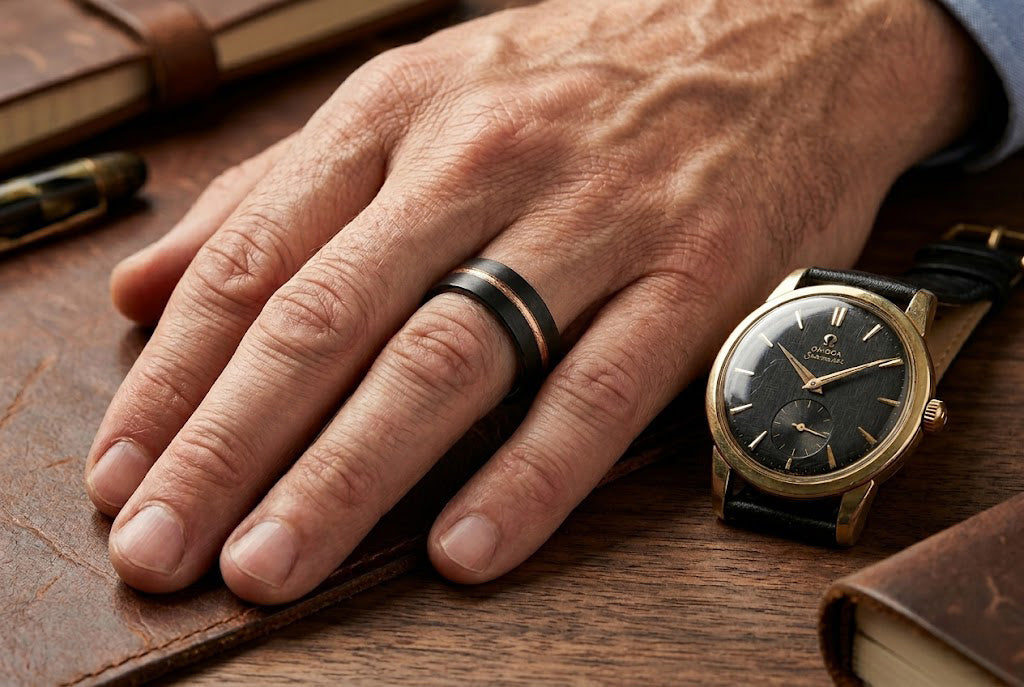
The short answer: the 8mm vs 6mm wedding band decision comes down to three things — the size of your hand, the kind of work it does, and how present you want the ring to feel. 8mm carries a quiet substance. 6mm reads classic and quiet. Most men with average-to-larger hands will prefer 8mm. The actual rule is simpler than it sounds, and we'll walk through it.
Wedding band width is one of those decisions that seems trivial until you're wearing the wrong one for forty years. Two millimeters doesn't sound like much. On a finger, it changes the entire character of the ring.
What 8mm and 6mm actually look like in person
A 6mm band is roughly the width of a No. 2 pencil's hex flat. It sits slim on the hand. From across a table, you'd notice the metal but not necessarily the proportions. Most traditional men's wedding bands from the 1950s through the 1980s were 4–6mm. It's the historical default.
An 8mm band is closer to the width of two stacked dimes. It has visible presence. It reads as a deliberate object on the hand — the kind of ring that registers when someone shakes your hand. Modern men's wedding bands have trended toward 8mm for the last twenty years, partly because tungsten and ceramic let designers run wider without the band feeling chunky.
Archer Wade's collection is 8mm across all twelve rings. That's not a default — it's a design call. We'll cover why later in this piece.

Hand size matters more than people think
The same 8mm band reads differently on a 7-knuckle and a 10-knuckle. A small-handed man in a wide band can look like he's wearing his father's ring. A large-handed man in a narrow band can look like he forgot to upgrade.
A rough rule that holds up: if your dominant ring finger sizes between 7 and 9, both 6mm and 8mm work — pick on personality. If you're a size 10 or larger, 8mm is going to look proportional in a way 6mm won't. If you're under size 7, 6mm tends to read better, though some men deliberately want the heavier proportion of 8mm even on smaller hands.
The honest test: try both. Cut a strip of paper to 6mm, another to 8mm, wrap each around your finger, and look at it in the mirror. It's not the same as a real ring on a real hand, but it's surprisingly close.
Width affects how the ring feels, not just how it looks
Wider bands have more surface contact with the finger. That's mostly comfortable — the weight distributes — but it also means more of the ring touches when you grip a steering wheel, a mug, a barbell, your kid's hand. Some men love that grounded sensation. Others find it intrusive in the first few months and don't adjust.
Narrower bands move more on the finger. They spin if they're slightly too loose, which can be either fine or annoying depending on your tolerance. They're slightly easier to remove, which matters for men who take the ring off for hands-on work.
Comfort-fit interiors close some of this gap. A comfort-fit 8mm tungsten band feels closer to a standard-fit 7mm gold band than the raw measurements suggest. The beveled inside edge means less of the ring's vertical wall pressing into the finger.
Width and the kind of work your hands do
A surgeon, a mechanic, a chef, a carpenter — each of them deals with something tight, something narrow, something that pinches. Wider bands present more material to catch on. Narrower bands clear obstacles more easily.
This is the one place width actually has a functional answer rather than an aesthetic one. If your work involves frequent close-quarters hand activity — surgical gloves, machine work, pulling tools through narrow spaces — a 6mm band has a small but real advantage. If your work is mostly desk-based or lifestyle-flexible, the difference is negligible and you can pick on look.
Worth noting: men in physically tight-quarters work often take their wedding band off entirely during work hours. Width matters less in that case than the ring's durability when it's on at home or out. That's where tungsten carbide's scratch-resistant design — 8.5 to 9 on the Mohs hardness scale, second only to diamond among materials used in jewelry — actually compounds in importance.
Why Archer Wade builds at 8mm across the catalog
Three reasons. The first is design coherence. We make twelve rings; standardizing the width keeps the collection reading as a unit rather than a grab bag. A man choosing the Heritage Band and a man choosing the Forge Band end up with rings that share proportions — different finishes, different materials, same architecture.
The second is that the materials we work with — tungsten carbide, real meteorite, wood inlays — show better at 8mm. A meteorite band in 6mm is a hint of meteorite. The same band in 8mm shows the Widmanstätten pattern clearly. The materials earn their place at the wider proportion.
The third is that 8mm reads modern without reading aggressive. The chunky 10mm-and-up bands of the early 2010s are dating fast. 6mm reads vintage in a way some men love and some men want to avoid. 8mm sits in the middle — present but restrained.
This isn't a universal answer. There are men whose hand size or work or temperament fits 6mm better. For those men, gold or titanium bands at 6mm are widely available. We've made a different bet with this collection.
How to decide for yourself
Three questions, in order of weight.
First — what feels right when you try a band on? If you can get to a jewelry store with sample bands in both widths, take fifteen minutes and feel the difference. The decision often makes itself.
Second — what does your hand do in a normal week? If your work is hands-on and tight, lean narrower. If your work is anything else, the question is purely aesthetic.
Third — what does the ring need to look like in twenty years? Both widths age fine in tungsten. But the wider band tends to read as a more deliberate choice, and deliberate choices age better than default choices.
If you're between widths and can't decide, lean wider. It's easier to grow into a ring that announces itself slightly than to grow into a ring that disappears.
Frequently Asked Questions
Is 8mm too wide for a men's wedding band?
Not for most men. 8mm has been a common width for men's wedding bands for the last two decades, particularly in tungsten and ceramic. It reads substantial without reading aggressive. Men with smaller hands (size 7 and below) sometimes prefer 6mm for proportion, but for average-to-larger hands, 8mm is well within the standard range.
What's the most popular wedding band width for men?
8mm has been the dominant width for men's tungsten and ceramic wedding bands for the last twenty years. Traditional gold and platinum bands more often run 6mm. The shift toward wider bands tracks with the rise of tungsten in the men's wedding band category — wider proportions show the material's finishes better.
Will an 8mm band feel uncomfortable?
Not with a comfort-fit interior. The beveled inside edge of a comfort-fit 8mm band makes it feel closer to a 7mm standard-fit band on the finger. Most men adjust to the proportion within a week. A slightly tight 8mm at the base will settle in; a slightly loose 8mm will feel even more present than expected, so size accurately.
Can you get Archer Wade rings in 6mm?
Not currently. The collection is 8mm across all twelve SKUs by design — the materials and design language are calibrated for the wider proportion. Men who specifically want a 6mm men's wedding band may find better fit at brands that specialize in that width.
Does width affect how easy a tungsten ring is to remove in an emergency?
Slightly. Wider tungsten bands take a few more cracks with vise-grip pliers — the standard emergency-room removal method for tungsten — but the difference is seconds, not minutes. Both 6mm and 8mm tungsten can be safely removed in any emergency room equipped with locking pliers.