If your daily routine involves heavy tools, barbells, or rough environments, traditional wedding bands aren't just impractical; they are often temporary heavy tools, barbells, or rough environments, traditional wedding bands aren't just impractical; they are often temporary.
Gold bends under pressure. Platinum develops a dull patina of micro-scratches within months on a job site. This fundamental lack of durability in precious metals has driven a massive shift toward alternative materials, with tungsten carbide leading the market.
When considering this material, the most frequent question we receive is some variation of: Are tungsten rings actually scratch-proof?
The precise answer is no. Nothing in the jewelry world, not even a diamond, is entirely scratch-proof. However, tungsten carbide is, without question, the most scratch-resistant metal available for a wedding band. It is built to handle tools, sweat, travel, and the elements while maintaining its original finish for a lifetime.
To understand why a tungsten band can survive a weekend on the trail or a decade in the workshop without losing its polish, we need to look at the metallurgy, the physics, and the necessary trade-offs of extreme hardness. This is the truth about tungsten's durability.
The Science: Scratch-Proof vs. Scratch-Resistant
To truly understand scratch resistance, you must understanding the Mohs Scale of Mineral Hardness. This scientific scale ranks materials from 1 (softest, like talc) to 10 (hardest, like diamond).
A defining rule in material science is simple: a material can only be scratched by a substance with a higher Mohs rating.
Consider the reality of daily wear. Everyday dust and dirt contain tiny particles of silica (quartz), which ranks at a 7 on the Mohs scale. This environmental silica is the enemy of traditional jewelry.
Traditional metals like 14k gold and sterling silver rank between 2.5 and 3.5. Platinum is roughly 4.0 to 4.5. Titanium, which is celebrated for its strength, is only a 6. Because all of these metals rank lower than the silica in ordinary dust, they inevitably develop micro-scratches and dull over time simply from daily life.

Tungsten carbide ranks an incredible 8.5 to 9 on the Mohs scale. (For context, industrial abrasives like corundum rank at 9). Because tungsten carbide is harder than environmental silica, everyday friction literally cannot scratch it. Your car keys, loose coins, or the hardened steel edge of a wrench will glide across the surface without leaving a mark.
So, what can scratch tungsten? Only materials that match or exceed its rank:
-
Diamonds (Mohs 10): A diamond will easily score a tungsten band. If a tungsten ring is stored loose in a drawer next to a diamond engagement ring, the diamond will win.
-
Sapphires and Rubies (Mohs 9): These common gems can scratch the surface.
-
Industrial Abrasives: Certain sandpapers (e.g., silicon carbide) or tools containing diamond powder are harder than tungsten and will cause true scratches.
The Catch: Understanding Finishes and Inlays
There is a critical nuance in the tungsten market that many retailers overlook. While the raw, silver-toned tungsten carbide base is incredibly scratch-resistant, the exterior design elements often are not.
If you are buying a classic, high-polish, natural tungsten ring, you are receiving the raw benefit of the metal’s properties. However, modern designs often prioritize style pairings, which changes the durability dynamic.
The Nuance of Colored Tungsten
Black, blue, gunmetal, or rose-gold tungsten rings are typically created through Ion Plating (IP) or Physical Vapor Deposition (PVD). This process bonds a micro-thin layer of color (often titanium or zirconium compounds) to the tungsten surface.
While the tungsten base underneath remains pristine, the plated color layer itself is often only slightly harder than stainless steel. If subjected to intense abrasion—like grinding your hand against a concrete block wall—the colored plating will show scratches, potentially revealing the natural silver-colored tungsten beneath.
The Nuance of Multi-Material Inlays
The same vulnerability applies to rings with inlays. Many premium bands feature natural inlays made of wood, carbon fiber, antler, stone, or even gold. These materials are set into a precision-cut channel in the tungsten and sealed (often with a high-grade resin).
If you drag your ring against a rough surface, the tungsten edges will emerge unscathed, but the softer inlay material in the center will scratch or scuff.

The Real-World Trade-Off: Hardness vs. Brittleness
In materials science, there is an established, inverse relationship between hardness and malleability (the ability to bend or flex). Hardness usually implies brittleness. Because tungsten carbide is so exceptionally hard, it has zero flex. If extreme stress is applied, it will not bend or dent; it will shatter.
If you drop a gold ring onto a ceramic tile floor, it will likely dent. If you drop a tungsten ring from chest height onto the same tile, there is a very real chance it will chip or crack like heavy glass. This is the material trade-off: you receive near-permanent scratch resistance, but you must respect that the metal is brittle.
Shattering the Emergency Removal Myth
This lack of malleability is at the heart of the most persistent and dangerous myth surrounding tungsten rings: Tungsten rings cannot be removed in a medical emergency, leading to finger loss.
This claim is not only false; it is the exact opposite of the truth. From a practical safety standpoint, a tungsten ring is often far safer in an industrial accident than a gold or titanium band.
If your hand is crushed under heavy equipment, a malleable gold ring will bend and constrict your finger, cutting off circulation. A tungsten ring cannot bend to crush your finger; if the pressure is extreme enough, it will simply shatter, immediately relieving the compression.
Furthermore, if your finger swells due to an injury and the ring becomes stuck, emergency rooms and EMTs do not need specialized diamond-tipped saws. They use common locking pliers (vice grips). By applying focused pressure to the exterior of the ring and tightening, the brittle tungsten will safely fracture into two clean pieces in a matter of seconds.

Who Should Wear a Tungsten Ring?
Tungsten is a material designed for specific types of ownership. It is not for everyone, but for the correct individual, it is the only logical choice.
Ideal Candidates for Tungsten:
-
Tradesmen, Engineers, and Mechanics: If you are gripping steel wrenches, operating machinery, or handling rough materials daily, a tungsten band will survive the workshop where gold would be destroyed in a season.
-
Active Lifestyles and Travel: Weightlifters, climbers, and travelers appreciate the grounding weight of the ring and its ability to shrug off contact with rocks or knurled barbells.
-
Low-Maintenance Owners: If the idea of taking a ring to a jeweler every two years for re-polishing is unappealing, the permanent luster of tungsten is unmatched.
Who Should Avoid Tungsten:
-
Those Anticipating Size Fluctuations: Because tungsten cannot be cut and re-soldered without destroying its structure, it cannot be resized. If your weight fluctuates significantly, you must replace the ring entirely.
-
Ultralight Enthusiasts: If you prefer a ring you barely feel, tungsten—one of the densest metals used in jewelry—will feel too heavy. You will prefer titanium or carbon fiber.
Summary Comparison: How Tungsten Stacks Up
|
Metal |
Mohs Hardness Rating |
Scratch Resistance |
Behavior Under High Impact/Stress |
Density (Weight) |
|
Tungsten Carbide |
8.5 – 9.0 |
Extremely High |
Shatters cleanly (safely) |
Heavy (approx. 18k gold) |
|
Titanium |
6.0 |
Moderate |
Bends/scratches |
Ultralight |
|
Platinum |
4.0 – 4.5 |
Moderate |
Dents/scratches |
Very Heavy |
|
14k Gold |
2.5 – 3.5 |
Low |
Easily bends/scratches |
Moderate |
Care, Cleaning, and Long-Term Ownership
Maintaining a high-quality tungsten ring requires very little effort, provided you avoid a few critical pitfalls.
-
Routine Cleaning: Wipe the ring with a clean, soft microfiber cloth. For deeper cleans, use warm water and mild dish soap.
-
Chemical Exposure: While the tungsten is resilient, harsh chemicals like chlorine and bleach can damage the metal binder (often nickel or cobalt, depending on quality). prolonged exposure can compromise the ring’s integrity.
-
Avoid Ultrasonic Cleaners: This is particularly important for any ring containing a natural wood, antler, or stone inlay. The high-frequency vibrations can degrade the inlay seal over time.
-
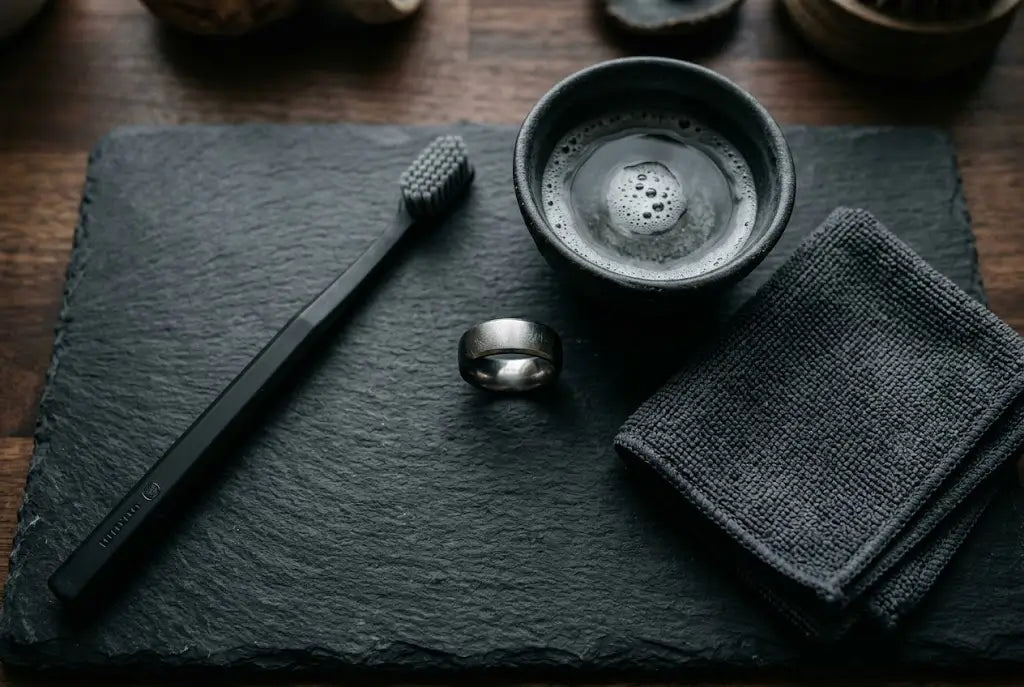
The "Scuff" or "Transfer" Mark: A common issue occurs when a tungsten ring rubs against a softer surface, like a galvanized steel pole. The ring actually scrapes a small layer of the softer metal onto itself. It looks like a scratch, but it is actually material transfer. You can remove this by scrubbing the ring with soap and a stiff nylon brush (like a toothbrush).
Frequently Asked Questions
Do tungsten rings tarnish or rust?
No. Premium tungsten carbide, forged with a nickel binder, is completely inert. It will not oxidize, rust, tarnish, or corrode, regardless of exposure to sweat, water, or the ocean. Rings that turn your finger green are made with cheap cobalt binders, which oxidize rapidly.
How heavy is a tungsten ring?
Tungsten is a dense metal, roughly 15.6 g/cm³. For context, this makes it very similar in weight to 18k gold (approx. 15.5 g/cm³), but slightly less dense than 24k gold (19.3 g/cm³). If you prefer a band that feels grounded and substantial on the hand, you will appreciate tungsten.
Is tungsten hypoallergenic?
Yes, high-grade jewelry is entirely cobalt-free. We use a nickel-binder sintering process. While raw nickel is an allergen, the molecular bonding process in tungsten carbide locks the nickel so tightly that <1% of the population experiences a reaction. Cheap industrial rings use cobalt, which leaches via sweat, causing oxidation and rashes.Reputable brands explicitly guarantee a cobalt-free composition.
How does tungsten removal in an emergency compare to titanium?
Tungsten is safer and faster. Because tungsten is brittle, it can be shattered cleanly in seconds using locking pliers (vice grips). This relieves pressure instantly. Titanium, because it is malleable and tough, often requires specialized medical saws to cut through, which is a slower process.
Can a scratched tungsten ring be polished?
A true scratch (caused by a diamond or industrial abrasive) is permanent for most jewelers. It can only be buffed out using specialized machinery and diamond polishing compounds. Minor "scuffs" or material transfer can be scrubbed away at home.

The Archer Wade Standard
At Archer Wade, we believe a wedding band should be built to withstand the life you actually live. We focus on natural materials, precise engineering, and rugged utility.
Our collections are crafted from high-grade, cobalt-free tungsten carbide, ensuring you get the full, hypoallergenic benefit of the metal’s permanent scratch resistance. We pair this industrial strength with precisely comfort-fit inner profiling and premium natural inlays to create a band that is both rugged and refined.
We invite you to unbox an Archer Wade band and feel the density. Your ring is an investment in your story, and it is designed to last the journey.