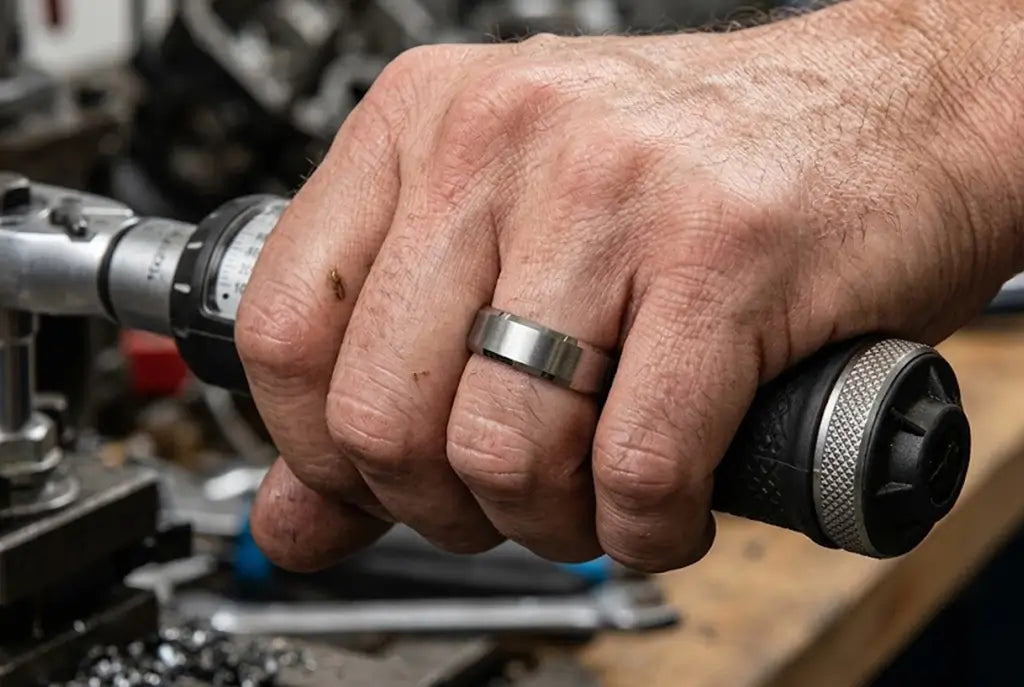
The short answer: comfort fit vs standard fit wedding bands differ on the inside, not the outside. A comfort-fit band has a beveled, slightly domed interior — easier to slide on, more forgiving over knuckles, less surface contact with the finger. A standard-fit band has a flat interior surface that grips the finger more uniformly. Comfort fit usually requires sizing down half a size from your standard-fit size. The detailed answer is below.
Most men buying their first wedding band have never heard the terms 'comfort fit' or 'standard fit' before they're being asked to choose between them. Then they discover that the choice changes how the ring sizes, feels, and ages. Worth a few minutes to understand.
What comfort fit actually means
Picture the cross-section of a wedding band. A standard-fit ring is essentially a flat tube — straight inside walls, sharp inside corners where the inside meets the edges. The whole inner surface presses evenly against the finger.
A comfort-fit ring has the same outside profile, but the inside is shaped like a slight dome — slightly thicker in the middle, slightly thinner at the edges. The corners are bevelled or rounded. The ring contacts the finger at a single ridge in the center rather than across the whole inside surface.
Two practical results follow. First, the ring slides over the knuckle more easily — less friction, no sharp edges catching. Second, the actual interior diameter at the edges is slightly larger than the labeled size, even though the ring still 'fits' that size.
Why this changes how you size
Because of the geometry, comfort-fit bands typically wear about half a size larger than their labeled size. A man who wears a size 9.5 standard-fit ring will usually wear a size 9 comfort-fit ring. The ring 'reads' the same size on the finger because the contact is in the middle, but the labeled size accounts for the easier slide-on.
This is why every reputable men's wedding band brand that sells comfort-fit will tell you to either size half a size down from your normal ring size, or — much better — measure your finger using a sizer kit specifically designed for the fit you're buying.
Tungsten makes this more important than it would be for gold. Gold can be resized; tungsten can't. If you size a comfort-fit tungsten ring using a standard-fit measurement, the ring arrives loose and you can't fix it without a full replacement.

Which one feels better?
Most men who try both prefer comfort fit. The reasons are subtle but consistent.
The ring forgets it's there, more often. Comfort-fit's reduced contact surface means the wearer doesn't notice the ring during routine grip activities — typing, holding a coffee cup, gripping a steering wheel. Standard-fit bands maintain a more constant 'present' feeling on the finger.
It accommodates daily finger fluctuation better. Fingers swell with heat, after exercise, late in the day, after salty meals. The bevelled edges of a comfort-fit band leave more room at the points where swelling tends to bind first. A slightly tight standard-fit band can feel uncomfortable by evening; a slightly tight comfort-fit band is more forgiving.
It's easier to remove when you need to. The same beveled geometry that helps it slide on helps it slide off — over a swollen knuckle, in a hurry, when the finger has changed temperature.
There are reasons to prefer standard fit. Some men want the ring's presence to be more constant — they like noticing it. Others find comfort fit feels slightly less 'solid,' even if the actual mass of metal is similar. These are personal preferences, not arguments for or against.
Why Archer Wade builds all rings comfort-fit
Three reasons. The first is that the brand's audience is buying for everyday wear over decades — not for occasional formal use. Comfort fit ages better through forty years of daily wear than standard fit does.
The second is that tungsten's hardness makes the comfort-fit advantage more meaningful. Tungsten doesn't bend or flex with the finger the way gold and platinum do. The bevelled interior is what gives the wearer back the small accommodations a softer metal would provide naturally.
The third is sizing accuracy. Comfort fit's slightly more forgiving geometry reduces the likelihood that a customer ends up with a ring that's marginally wrong — a critical concern for tungsten, which can't be resized. The free ring sizer kit pairs with comfort-fit better than with standard fit because the sizer rings themselves are typically comfort-fit, matching the real ring.
How to size a comfort-fit ring at home
If you've never worn a wedding band, get a free ring sizer kit and try the closest sizes for a full day each. The geometry of the sizer ring should match the geometry of the ring you're buying — order from the same brand.
If you already wear a ring on the same finger, check whether it's comfort-fit or standard-fit. If standard-fit, the comfort-fit version of the same labeled size will likely be slightly loose; size down half a size. If you don't know which fit your existing ring is, the easiest way is to measure the inside diameter and compare to a standard sizing chart.
Whatever you do, don't trust the string method as your only measurement. We covered this in the sizing guide; the same caveat applies double for tungsten.
If you're choosing between the two
For most men, comfort fit is the right default. It's the standard for tungsten, ceramic, and most modern men's wedding band designs. The cost premium over standard-fit, where it exists, is small.
The one place to actively consider standard fit: if you specifically want the 'present' feeling of a constant-pressure ring on the finger, and you're wearing the band primarily in formal contexts rather than everyday wear, standard-fit gold bands have a long traditional history that comfort-fit rings can't quite replicate.
For everything Archer Wade is — daily wear, modern heirloom, designed for the next forty years — comfort-fit is the right call.
Frequently Asked Questions
What's the difference between comfort fit and standard fit wedding bands?
Comfort-fit bands have a slightly domed interior with bevelled edges; standard-fit bands have a flat interior. Comfort fit slides over the knuckle more easily and contacts the finger at a smaller surface, making it more forgiving through finger swelling and daily wear. Standard fit grips the finger uniformly across the whole inside surface.
Should I size up or down for comfort fit?
Down half a size, typically. A comfort-fit ring labeled the same size as your standard-fit ring will feel slightly loose because the bevelled interior reduces contact at the edges. Most brands recommend sizing down half a size when switching from standard to comfort fit — or, ideally, measuring with a sizer that matches the fit of the ring you're buying.
Is comfort fit worth the price?
If there's a price difference at all, yes — for everyday wear. Comfort fit accommodates finger swelling better, slides on and off more easily, and is generally preferred by men who wear their wedding band all day. Some brands charge a small premium for comfort-fit; others (including Archer Wade) build all rings comfort-fit by default.
Are all tungsten rings comfort fit?
Most are. Tungsten's hardness makes the comfort-fit interior more meaningful — the metal doesn't flex with the finger the way gold does, so the geometry of the bevelled interior compensates for that lack of natural give. A few budget tungsten brands sell standard-fit; for any premium tungsten ring at $100+, comfort fit is the standard.
Can a comfort-fit ring be resized?
Gold and platinum comfort-fit rings can be resized, the same as standard-fit. Tungsten comfort-fit rings cannot be resized — same as standard-fit tungsten. The fit type doesn't change the resizing characteristics; the metal does.