The short answer: the best wedding rings for surgeons and healthcare workers are simple, smooth, hypoallergenic, and low-stakes enough that losing it isn't a crisis. Most physicians and nurses we've talked to settle on tungsten or silicone — sometimes both, on rotation. Diamonds and detailed designs don't survive the job. Here's what actually matters.
Healthcare is one of the few professions where a wedding ring has to do a real, demanding job — survive constant hand-washing, tolerate gloves, stay clear of sterile fields, not catch on monitors or IV lines, and be removable in seconds when something goes wrong. Most jewelry-store advice ignores this entirely. We'll try not to.
What healthcare actually demands of a wedding band
Five things matter, in roughly this order:
Hand-washing tolerance. A surgeon may scrub in twenty times in a single shift. A nurse may wash hands fifty times. Antibacterial soap, hot water, repeated friction. Materials that tarnish or develop micro-corrosion (lower-karat gold with nickel content, some plated finishes) wear visibly within a year.
Glove compatibility. The ring sits between latex and skin all day. Texture matters — bands with raised inlays, prong settings, or sharp edges puncture gloves. Smooth-profile bands are the standard.
Hypoallergenic surface. Hours of glove sweat and friction concentrate against the ring's contact surface. Even men who don't normally react to nickel often develop contact dermatitis under glove conditions. Tungsten carbide (with a nickel-free binder) and pure platinum are the safest defaults.
Field clearance. Sterile fields, MRI rooms, lab environments. Some hospitals have explicit no-jewelry policies for OR personnel. Others are looser. Most physicians end up with a routine: ring off in the morning, ring on at the end of the shift.
Disposability. The reality is that healthcare workers lose, damage, and have to remove their wedding bands more than almost any other profession. A $1,200 platinum band that lives in a locker is overpriced for the actual time it's on the hand.

Why tungsten makes sense for most healthcare workers
Tungsten carbide handles four of those five demands well. It's nickel-free in reputable brands, hypoallergenic in practice, holds its finish through tens of thousands of hand-washings, and runs $149–$199 — accessible enough that locker-storage isn't financially painful, and replacement at the warranty rate isn't catastrophic.
The fifth demand — emergency removal — is where tungsten's reputation gets unfairly punished. The myth is that tungsten can't be removed in an emergency. The reality is the opposite. Tungsten carbide is brittle, which means it cracks cleanly under vise-grip pressure in a few seconds. Most emergency rooms keep the tools on hand specifically for tungsten and ceramic rings. Gold and titanium, both of which bend under pressure, often take longer to remove with traditional ring cutters.
Translated for someone in healthcare: a tungsten ring is, if anything, faster to deal with than a gold one when something happens to your hand.
The rotation pattern most physicians settle into
Talk to enough healthcare workers and a pattern emerges. Many keep two rings:
A tungsten or platinum band as the primary ring. Worn outside of work hours, on dates, at family events, in the photographs. The real ring.
A silicone band for clinical hours. Inexpensive, easily replaced, cleared by hospital policy almost everywhere, glove-safe, and removable instantly. Brands like Enso, QALO, and Groove make these. They're disposable on purpose.
This isn't compromise — it's a wardrobe approach to a piece of jewelry that has different jobs at different times. The same surgeon who wears a satin tungsten band to a wedding-anniversary dinner wears a $20 silicone band in the OR. Both rings represent the same marriage. They just operate in different environments.
Archer Wade doesn't make silicone bands. We make the primary ring — the modern heirloom that goes on the hand outside of clinical hours and stays in the locker during the shift. The silicone backup is something most healthcare workers end up buying separately.
What to avoid
A few specific things that don't survive healthcare work:
• Diamond settings or any prong-set stones. Catch on gloves, harbor bacteria in the prongs, fail hospital infection-control standards in many cases.
• Wood inlays, meteorite, or any porous material. The materials that look beautiful in everyday wear absorb soap, antiseptic, and skin oil under healthcare conditions. They degrade faster than the metal.
• Lower-karat gold (10k–14k) with nickel content. Skin sensitization is common under glove conditions even in men who don't normally react.
• Aggressive textures or cross-hatched finishes. Hard to clean, harder to keep sterile-feeling.
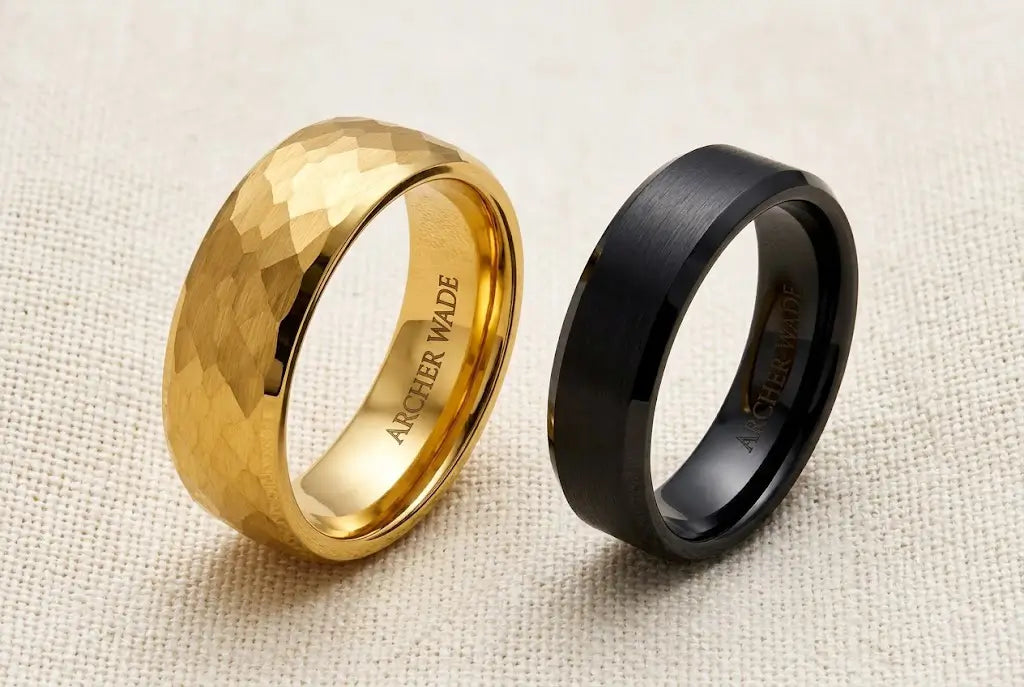
This means most of Archer Wade's collection — the Trailhead, the Quarry, the Summit, the Forge — isn't the right fit for clinical wear. The Heritage Band, the Sentinel Band, the Axis Band, and the Nightfall Band all work well: smooth profiles, no inlays, brushed or satin finishes that handle daily wear without showing it.
If you're choosing one ring
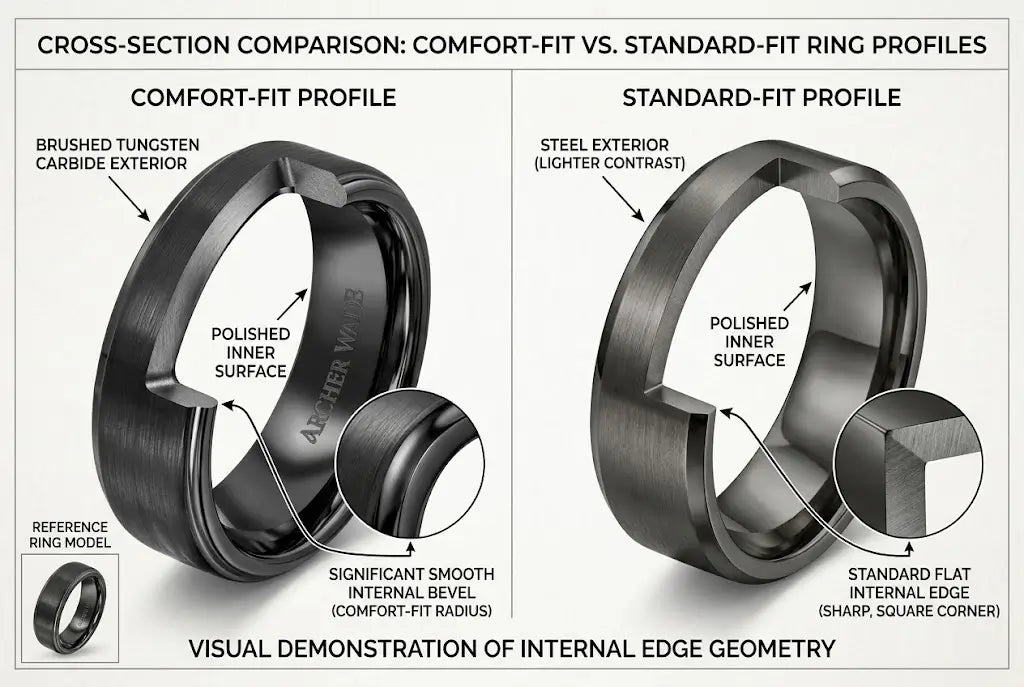
Most healthcare workers we've heard from end up at the same place: a smooth-profile, brushed-tungsten band in 8mm comfort-fit, paired with a silicone backup for the actual shift. Total investment: roughly $170 plus $20 for the silicone.
The ring on your hand for forty years should reflect the man, not the job. The job ring is something else — something practical, replaceable, and not asked to do work it wasn't built for. Both serve the marriage. Don't ask one to do both.
Frequently Asked Questions
What is the best wedding ring for a surgeon?
A smooth-profile tungsten or platinum band, paired with a silicone backup for clinical hours. Tungsten handles repeated hand-washing, glove pressure, and hypoallergenic requirements well at $149–$199. The silicone covers actual OR or sterile-field hours when policy or practicality requires no rigid jewelry.
Can surgeons wear wedding rings during surgery?
Hospital policies vary. Many require no jewelry for OR personnel during sterile procedures; others allow smooth-profile bands. Most surgeons we've heard from default to keeping the ring out of clinical hours regardless of policy — the friction with gloves and frequent scrubbing makes it impractical.
Are tungsten rings safe for healthcare workers?
Yes — and they're often the best choice. Tungsten carbide with a nickel-free binder is hypoallergenic, holds its finish through frequent hand-washing, and can be removed faster in an emergency than gold or titanium (vise-grip cracks tungsten cleanly in seconds). The ring's brittleness, sometimes treated as a flaw, is a safety advantage in clinical contexts.
Why do nurses wear silicone rings?
Three reasons: hospital policy compliance, glove safety, and disposability. Silicone bands are flexible, won't catch on equipment, are cheap to replace if lost or damaged, and meet most institutional jewelry policies. Many healthcare workers wear silicone during shifts and a more substantial ring (tungsten, platinum, gold) outside of work.
Can you wear a wedding ring under surgical gloves?
Smooth-profile bands generally fit under gloves without issue. Bands with inlays, raised settings, or sharp edges can puncture latex and are typically removed before scrubbing in. Comfort-fit interior profiles are easier under gloves than standard-fit bands.