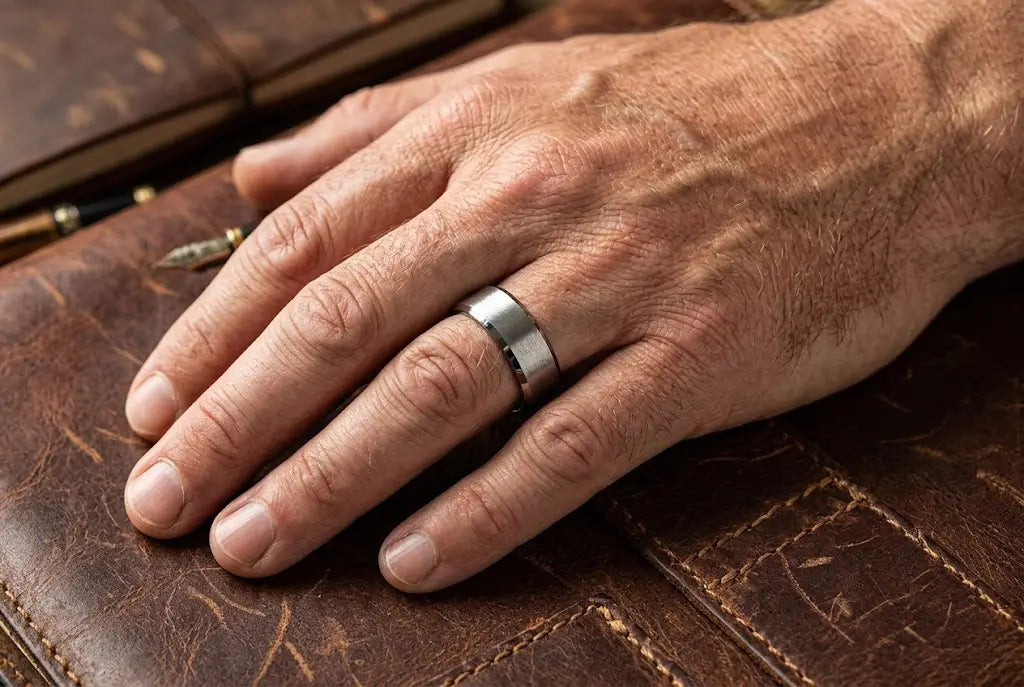
The short answer for tungsten vs gold wedding bands: tungsten is harder, more scratch-resistant, and cheaper. Gold is more traditional, repairable, and resizable. Tungsten is better for the man who actually uses his hands. Gold is better if heirloom-as-metal matters more than heirloom-as-design. The longer answer is below.

Tungsten carbide registers around 8.5–9 on the Mohs hardness scale. Gold sits between 2.5 and 4, depending on the karat. That difference is enormous — it's the difference between a metal that scuffs against a steering wheel and a metal that doesn't notice.
In practical terms, a 14k gold band picks up visible micro-scratches inside the first month of daily wear. By year five it has a softened, lived-in look — which some men love and some men don't. A tungsten band looks essentially the same on day 1,800 as it did on day one. For a man whose work involves his hands, that matters. For a desk worker who wants the patina, gold's softness is a feature, not a bug.
One caveat: tungsten's hardness comes with a trade-off. Where gold bends or flexes under impact, tungsten can crack. It's rare, but it's why tungsten warranties (including ours) cover replacement, not repair.
Price
A men's 14k gold wedding band typically runs $600–$2,500 depending on weight and finish. Solid platinum starts around $1,500 and climbs from there. Tungsten carbide bands of comparable construction quality usually price between $150 and $400.
The price gap doesn't reflect a quality gap. It reflects raw material cost — gold and platinum are precious metals tied to commodity prices, while tungsten is industrially abundant. A $200 tungsten band and a $1,200 gold band both ship from comparable manufacturing processes. You're paying for the metal, not the workmanship.
Resizing and Repair
This is gold's clearest advantage. A goldsmith can resize a gold ring up or down two sizes without much fuss. Solder joints, finger growth across decades, weight changes — all of it is handled by a routine bench job.
Tungsten can't be resized. The metal is too hard to cut and rejoin without compromising the structure. If your finger size changes — and most men's do, sometimes meaningfully, between thirty and sixty — a tungsten ring needs to be replaced rather than altered.
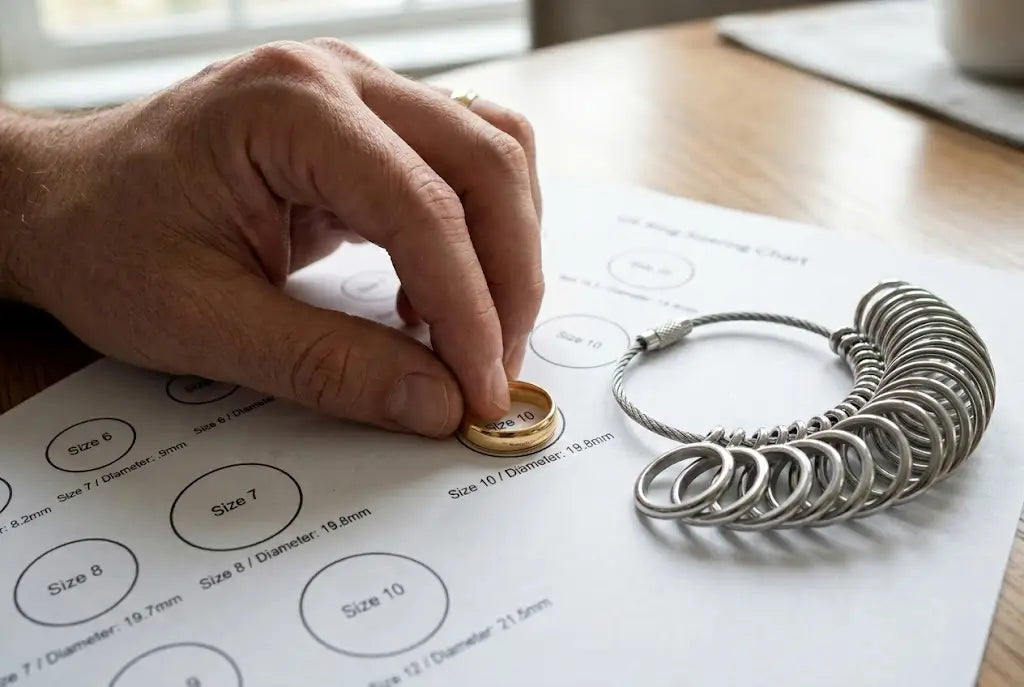
There are two things that mitigate this. First, a good lifetime warranty covers same-design replacement at a low warranty rate. Archer Wade's does. Second, accurate sizing at the original purchase matters more than it does for gold — which is why we send a free ring sizer kit before you buy.
Weight and Feel
Tungsten is dense — denser than gold, in fact. A tungsten band feels substantial on the hand, more so than its size suggests. For some men this is a feature: it feels real, it feels like something. For others it's a slight adjustment from the lighter-feeling gold bands they've worn before.
Comfort-fit interiors smooth this out for both metals. The beveled inside edge means the ring sits against the finger more like a tube than a flat band — which makes the weight feel grounded rather than heavy.

How a Tungsten or Gold Ring Ages Over Twenty Years
Gold develops what jewelers call "patina" — a softening, slightly hazed surface from the accumulation of micro-scratches. It's the look of a watch you've worn for fifteen years. Some men want this. The ring becomes a record of where it's been.
Tungsten holds. The brushed finish at year twenty looks like the brushed finish at year one. There's no patina, but there's also no degradation. The ring you bought is the ring you'll be wearing in 2046.
Neither is better. They're different theories of how an heirloom should age — gold treats the ring as a record of the wearer's life, tungsten treats it as a constant against which the rest of life happens. Choose accordingly.
Skin Sensitivity
Both pure gold and tungsten carbide are essentially hypoallergenic. The complications are in the alloys. Lower-karat gold (10k, sometimes 14k) contains nickel, which is the most common metal allergy in the U.S. — affecting roughly 17% of women and 3% of men. Tungsten carbide rings are usually nickel-free, though some cheaper brands use cobalt as a binder, which can cause its own issues. Reputable tungsten makers use a nickel-free, cobalt-free binder.
If you have known metal sensitivities, tungsten is generally the safer default. If you don't, both are fine.
Choosing Your Men's Wedding Band Material — Which One for You
Choose tungsten if: you work with your hands, you want the ring to look the same in twenty years as it does today, you're sensitive to the price gap, or you have a metal allergy. Choose gold if: the metal itself matters to you as the heirloom, you want a ring that develops a patina, or you anticipate significant finger-size changes ahead.
There's no wrong answer. There's only the answer that fits the kind of life you actually live.
Frequently Asked Questions
Is tungsten better than gold for a wedding ring?
It depends on your priorities. Tungsten is harder, more scratch-resistant, and significantly cheaper. Gold is repairable, resizable, and develops a softer patina over time. For a hands-on wearer at a smaller budget, tungsten is usually the better fit. For a man who wants the metal itself to be the heirloom, gold is the answer.
Will a tungsten ring last as long as gold?
In terms of finish and shape, tungsten will likely outlast gold. It doesn't bend, scratch, or wear thin. Gold softens and shows its years more visibly. The trade-off is that tungsten can crack under hard impact (rare) and can't be repaired or resized — gold can.
Can you tell the difference between tungsten and gold by looking?
Up close, yes. Tungsten in silver tones has a slightly cooler, more gunmetal feel than white gold. Rose-gold and gold-tone tungsten read warmer but slightly different from real gold. From a few feet away, most people can't tell. The point of a tungsten band isn't usually to imitate gold — it's to be its own thing.
Why do gold rings cost so much more than tungsten?
Raw material cost. Gold trades on commodity markets and has held value for thousands of years. Tungsten is industrially abundant. The construction quality of a $200 tungsten band and a $1,200 gold band can be functionally identical — you're paying for the metal, not the craftsmanship.
Can tungsten rings be resized like gold?
No. Tungsten is too hard to cut and rejoin without compromising the ring's structure. If your finger size changes, the ring needs to be replaced rather than altered — which is why a strong lifetime warranty matters and why getting the size right at purchase is more important than it is for gold.