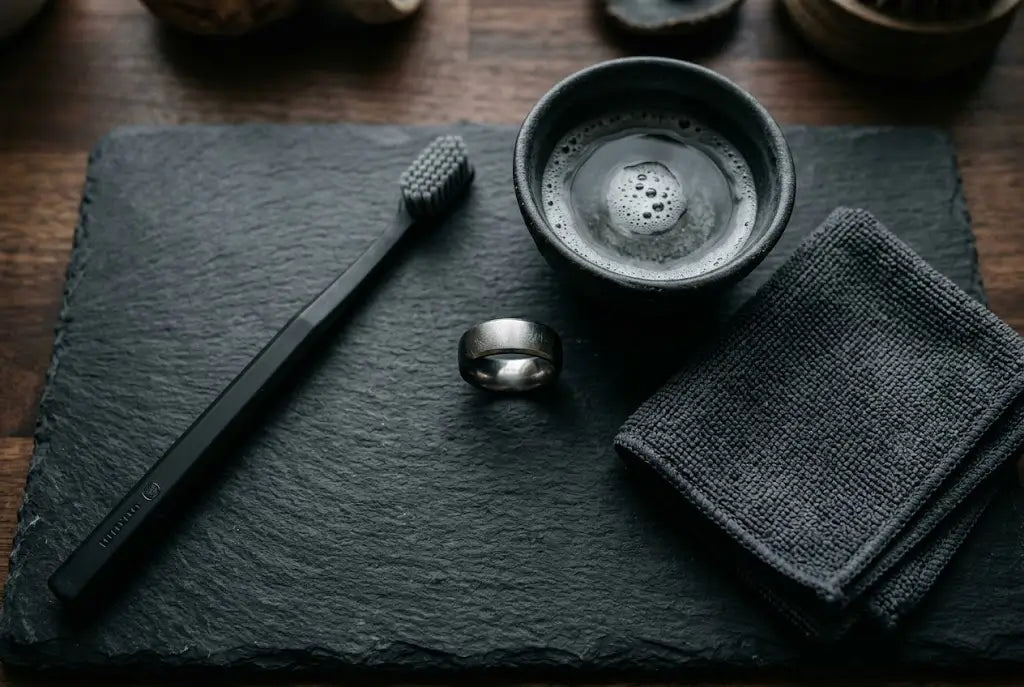
When men come to me looking for a wedding band, they usually have two things on their mind. First, they want something that looks good—something clean, modern, and rugged. Second, they want to know if it will actually survive their life.
Over the past few years, the demand for black wedding bands has exploded across the United States. A black ring pairs perfectly with a minimal aesthetic, everyday carry tools, and an active lifestyle.
But that deep, matte black finish carries a lot of anxiety:
-
Will it scratch on a steering wheel?
-
Will the color fade after a few months gripping a barbell?
-
Will it shatter if you drop it on the garage floor?
I've tested, worn, and curated these materials for years. The truth is, not all black rings are created equal. Durability depends entirely on the metal engineered beneath the surface, the exact alloy used, and the quality of the finish.
Here is everything you need to know about the durability of black wedding bands, grounded in real-world performance, so you can make an informed, confident decision.
The "Permanent Black" Myth: Solid vs. Coated Materials
The biggest misconception in the men's jewelry market is that a black ring is permanently black by default. In reality, most dark metals do not naturally occur in a jet-black state. They require engineering.
When you buy a black ring, you are usually looking at one of three distinct manufacturing processes:
-
Standard Electroplating (The Trap): Common with cheap online rings. This involves a basic stainless steel core coated with a thin layer of black rhodium. I advise against this. Standard plating will scratch, fade, and flake off within weeks, exposing the cheap silver metal underneath.
-
Physical Vapor Deposition / PVD (The Standard): A highly advanced vacuum coating used on premium materials like titanium and tungsten. PVD offers excellent daily wear resistance. However, under extreme friction (like scraping against steel tools), a PVD coating can still wear down over the years.
-
Thermal Oxidation & Solid State (The Permanent Solution): Materials like black ceramic are solid black all the way through. Black zirconium undergoes extreme heat treatment to grow a black oxide layer permanently bonded into the metal itself. These offer the most permanent, fade-proof color.
Material Breakdown: Ranking Black Rings by Durability
To find the right ring, you have to balance two specific metrics: Hardness (scratch resistance) and Toughness (the ability to bend or absorb impact without cracking).
Here is how the top contenders stack up in the real world.
Black Zirconium (The All-Around Champion)
If you want a metal ring with a permanent black finish, black zirconium is arguably the best option available. Zirconium starts as a grayish-white metal and oxidizes under extreme heat to create a hard, ceramic-like black exterior.
Why it works:
-
Chemically Bonded: The black layer is grown out of the metal, meaning it does not flake or peel.
-
High Scratch Resistance: It sits around a 7.5 on the Mohs hardness scale, easily handling desk work and gym equipment.
-
High Tensile Strength: It is tougher and far less brittle than other hard metals. If you drop it, it will not shatter.
Black Tungsten Carbide (The Scratch-Proof Heavyweight)
Tungsten carbide is famous for one distinct trait: it is incredibly hard. It possesses a satisfying, premium weight that many men prefer.

The Trade-offs:
-
Virtually Scratch-Proof Core: Sitting between 8.5 and 9 on the Mohs scale, only a diamond or sapphire can easily scratch the tungsten core.
-
Highly Brittle: Because it lacks malleability, a heavy strike with a steel hammer or a drop onto a tile floor can cause it to fracture or shatter.
-
PVD Coating Limits: Tungsten is naturally gunmetal gray. The black PVD coating on top can eventually wear away under heavy friction, even if the core never scratches.
Black Ceramic (The Permanent Lightweight)
Formulated from advanced non-metallic compounds and fired under immense heat, jewelry-grade ceramic is exceptionally durable.
The Trade-offs:
-
Solid Color: The massive advantage over tungsten is that ceramic is 100% black through and through. If you gouge it, it remains deep black underneath.
-
Scratch Resistance: Boasts an impressive 8.5 on the Mohs scale.
-
Brittleness: Like tungsten, it will shatter under extreme pressure or high-impact drops.
-
Feather-Light: Ideal for men who want a ring they can put on and immediately forget about.
Black Titanium (The Featherweight Contender)
Titanium is the backbone of aerospace engineering, famous for its unmatched strength-to-weight ratio.
The Trade-offs:
-
Structural Toughness: It strongly resists deep bending and deformation.
-
Patina Potential: Registering at a 6 on the Mohs scale, it will pick up microscopic scratches over time (which the everyday carry community calls a "patina").
-
Coating Wear: Heavy scratches may eventually reveal the silver-gray titanium underneath the black PVD coating.
Carbon Fiber & Silicone (The Active Alternatives)
If your daily life involves harsh environments, traditional metals might not be the right call.
-
Carbon Fiber: Ultra-lightweight and won't shatter, but the resin binding the fibers can be marred by harsh chemicals or extreme friction.
-
Silicone: Zero scratch resistance, but maximum safety. Designed to stretch and snap before it degloves or injures your finger in machinery.
The Hardness vs. Toughness Matrix
When making a premium purchase, clear data helps.
|
Material |
Scratch Resistance (Mohs) |
Shatter Risk (Toughness) |
Resizable? |
Color Permanence |
|
Black Zirconium |
High (~7.5) |
Low (Bends, doesn't break) |
No |
Excellent (Bonded Oxide) |
|
Black Tungsten |
Very High (8.5 - 9.0) |
High (Brittle, fractures) |
No |
Moderate (PVD wears first) |
|
Black Ceramic |
Very High (~8.5) |
High (Brittle, fractures) |
No |
Ultimate (Solid throughout) |
|
Black Titanium |
Moderate (~6.0) |
Very Low (Highly durable) |
Difficult |
Moderate (PVD Coating) |

Lifestyle Match: Which Ring Survives Your Day Job?
Selecting the right material is about matching the metal to your specific routine. A ring should fit seamlessly into your life, not hinder it.
For the Mechanic, Tradesman, or Construction Worker:
-
Top Picks: Tungsten Carbide, Ceramic, or Silicone.
-
Why: Scratch resistance is paramount. While tungsten and ceramic shatter, this is actually a safety feature in blue-collar trades. If a heavy object falls on your hand, the ring will shatter and fall away rather than crushing inward and pinning your finger.
For the Office Professional or Casual Gym Goer:
-
Top Picks: Black Zirconium or Black Titanium.
-
Why: They offer incredible comfort, are lightweight, and won't fracture if you accidentally knock them against a cast-iron weight rack at the gym.
For Men with Sensitive Skin:
-
Top Picks: Ceramic, Titanium, or Zirconium.
-
Why: Cheap rings often use nickel or heavy alloys that cause rashes. These three premium materials are highly biocompatible and proven to be 100% hypoallergenic.

The Emergency Room Question: Ring Removal and Resizing
Long-term ring ownership requires thinking about the future.
Emergency Removal:
-
Standard Metals: Gold and silver are easily cut with standard jeweler's saws.
-
Hard Metals (Tungsten/Ceramic): These defy standard saws. Emergency rooms use specialized ring cracker tools (similar to vice grips) to apply pressure until the ring cleanly cracks and falls away.
-
Tough Metals (Titanium/Zirconium): These require specialized diamond-tipped blades to cut through safely.
The Resizing Reality Check:
Because of the extreme hardness and manufacturing processes required, black tungsten, ceramic, and zirconium rings cannot be resized. If you gain or lose significant weight over the years, you will need to purchase a new ring. This is the standard trade-off for having a ring that resists daily damage so effectively.
Frequently Asked Questions (People Also Ask)
Do black wedding rings fade over time?
It depends entirely on the material. Solid black ceramic and thermally treated black zirconium will not fade. Standard electroplating fades very quickly. PVD coatings (on black tungsten or titanium) are highly resistant but can show fine wear after years of heavy friction.
Can a black tungsten ring really shatter?
Yes. Tungsten carbide is incredibly hard (highly scratch-resistant) but brittle. If hit with a heavy impact or dropped on concrete, it is designed to fracture rather than bend. Mechanics often view this as a safety feature to prevent finger crushing.
Are black rings hypoallergenic?
Premium black rings—like zirconium, titanium, and ceramic—are completely hypoallergenic. Cheap black rings, however, may contain nickel alloys that can irritate sensitive skin.
Can you resize a black wedding band?
Generally, no. Due to extreme hardness, black tungsten, ceramic, and zirconium cannot be safely cut, stretched, or welded for resizing. If your finger size changes drastically, a new ring is required.
How to Care for a Black Wedding Ring
Caring for a premium black wedding band requires very little effort. Keep it simple:
-
DO clean with soap: Wash your ring with warm water and a few drops of mild dish soap. Use a soft cloth to gently remove oils, dirt, and sweat.
-
DON'T use harsh chemicals: Avoid bleach, chlorine, and abrasive industrial cleaners.
-
DON'T expose coatings to solvents: While the metal cores survive, harsh chemicals can quickly degrade PVD coatings or weaken the resin on carbon fiber inlays. When doing heavy work with solvents, simply take the ring off.

The Archer Wade Standard
At Archer Wade, we believe a wedding band is more than just a piece of metal. It is a daily companion. It should represent commitment, yes, but it should also represent uncompromising quality.
We don't do hype, and we don't sell cheap plated steel. We focus strictly on materials that handle the realities of a man's life—sweat, tools, travel, and time. Whether you choose the unyielding scratch resistance of tungsten or the lightweight, permanent finish of black zirconium, the goal is always the same: to give you a piece of craftsmanship you never have to worry about.
If you are unsure of your size, or if you need help deciding which material fits your daily grind, we provide the sizing support and post-purchase care to ensure you get it exactly right. A premium ring deserves a premium experience, from the unboxing to the fiftieth year on your hand.