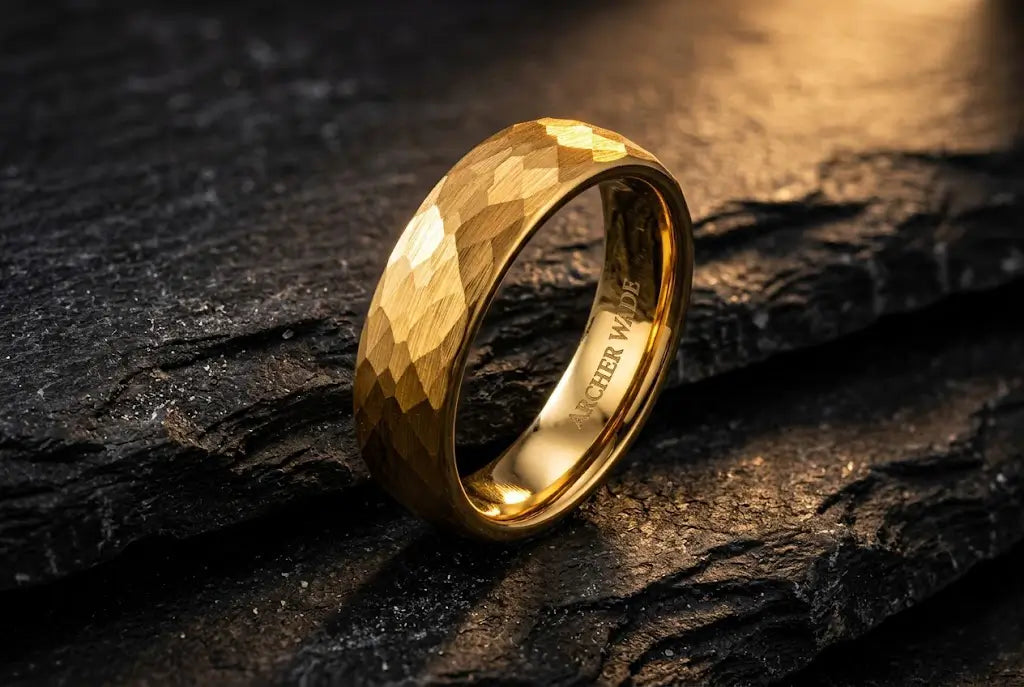
For the modern man, jewelry is rarely about excess. It is about utility, sentiment, and personal standards. Outside of perhaps a tie clip or cufflink, your wedding band and your watch are the only two items that enjoy permanent residence on your person. They are your daily carry.
For too long, arbitrary style rules dictated that these two items must match perfectly. If the watch case was stainless steel, the ring had to be platinum. This approach is outdated. It feels forced, lacking the character that defines true personal style.
At Archer Wade, we believe in curation, not carbon-copy matching. Your wrist should tell a cohesive story. The goal is harmony, not uniformity. If you wear a piece of equipment every single day, it should look intentional, not accidental.
This is the definitive guide to coordinating your wedding band and your timepiece, built on material science, proportion, and real-world wearability.
Dialing in the Metal Tones
The foundation of a unified wrist is understanding metal synergy. You do not need to identical materials, but you must respect how different metal hues interact. We categorize them simply: Cool, Warm, and Technical.
Cool Tones (Silver/Gray)
This category includes stainless steel, titanium, cobalt, and white gold. If your daily driver is a stainless steel sports watch—a diver, a GMT, or a chronograph—your band should generally live in this cool tonal family.
A brushed Titanium band pairs seamlessly with a brushed steel watch case. The tones are nearly identical, but the Titanium often carries a slightly darker, more utilitarian hue that shows you understand the difference between materials. It looks robust.
Warm Tones (Gold/Bronze)
Traditional yellow gold, rose gold, and bronze fall here. These are classic anchors. A polished 14k yellow gold band holds an undisputed heritage.
If you wear a luxury dress watch on a dark leather strap, a gold band is the natural companion. The leather warms up the steel of the watch case, creating a bridge to the warm gold on your finger. If you wear a solid gold or two-tone (steel and gold) watch, a yellow or rose gold band is required to ground the look.
Technical Tones (Black/Gunmetal)
Black PVD, DLC coatings, and darker Tungsten finishes are the modern tactical choice. These are not for traditionalists.
A matte black zirconium band pairs perfectly with a tactical field watch or a modern ceramic smartwatch. This combination signals an active, no-nonsense lifestyle. It is gear meant for work, not the boardroom.

The Architecture of Proportion: Visual Weight
Matching color is elementary. Matching proportion is where actual expertise is shown. We refer to this as the visual profile or visual weight of the gear. If the ratio is wrong, your hand looks unbalanced.
The Watch as the Anchor
The vast majority of modern men’s watches fit in the 40mm to 42mm case size range. This size offers a substantial presence without being dominant.
For a 40mm-42mm watch, you want a wedding band that can stand its ground. A 6mm to 8mm band is the industry standard for a reason. It offers visual substance that complements the steel weight on your wrist.
The Thin and Thick of It
If you inherit a slim, 34mm vintage grandfather’s watch, a chunky 9mm Tungsten carbide ring will visually swallow your hand. It looks accidental. You need a thinner, lower-profile band, perhaps 4mm, to match the delicacy of the vintage aesthetic.
Conversely, if you wear a massive 45mm professional dive watch or a bulky G-SHOCK, a delicate 3mm gold band gets completely lost. You need a substantial, heavy-duty band (8mm+), perhaps with beveled or rugged step edges, to provide the necessary visual counterweight.

Data Insights: Why Performance Materials are Winning
The landscape of men’s essentials is shifting. We can see this in consumer data and market research. In the US alone, the men’s wedding band market is projected to reach $1.66 billion by 2033, growing at a steady 4.1% CAGR. This growth isn’t just volume; it is a migration in material preference.
According to 2026 industry forecasts, alternative materials—specifically Tungsten Carbide and Titanium—are experiencing the fastest growth (7.6%). Why? Because American men are prioritizing longevity and resilience.
Gold and platinum are soft. They scratch and they bend. In a world of everyday carry and manual activity, men want equipment that performs. Tungsten is virtually scratch-proof and holds a heavy "heft" that feels significant. For the man who values his mechanical watch for its engineering, a performance-metal band offers that same engineering ethos. The band becomes another tool on his wrist, not just a symbol.
The Archer Wade Standard: Finish and Texture
This is the most critical element, often overlooked by non-experts. Color is visual, but texture is structural. At Archer Wade, we are obsessed with finishes. It defines the character of the ring.
Matched Finishes Bridging Metals
Can you wear a yellow gold wedding band with a stainless steel watch? Yes. It is common, especially if you inherited the watch or have a specific sentimental attachment to gold. The way to do it confidently is to match the finish.
A polished stainless steel watch bezel (the ring around the dial) should pair with a polished gold ring. The shared reflectiveness unites the two.
However, in 2026, the dominant trend is utility. Most tool watches (divers, pilots, chronographs) feature brushed or matte steel. To coordinate with this, we strongly recommend a satin or brushed finish on your band, regardless of the metal color. A matte finish absorbs light, giving off a rugged, utilitarian, and confident vibe. It hides the inevitable scratches of daily wear, unlike a mirror-polished finish. A brushed steel watch and a brushed gold ring look intentional. A polished ring next to a matte watch looks chaotic.

Real-World Wear and Long-Term Care
We must address the mechanics of wearing two hard objects in close proximity. This is a crucial "Your Money Your Life" (YMYL) consideration. If you wear luxury timepieces and a performance-metal band, you must understand the risks.
The Conflict of Hardness
Tungsten Carbide rates a 9 on the Mohs Scale of Hardness. Sapphire crystal (used on most luxury watch faces) is also a 9. Stainless steel is roughly a 5.5. 14k gold is a soft 2.5 to 3.
If you wear your watch and your wedding band on the same hand, they will clash. When your hand moves naturally, the ring may hit the watch. If you are wearing a Tungsten ring and a stainless steel watch case, that ring will scratch the steel. It will cut through it easily. If you are wearing a gold ring, the steel watch case will damage the gold ring over time.
For this reason, if you wear high-value mechanical watches, we strictly advise keeping your watch secured above the wristbone, or, preferably, wearing the watch and ring on opposite hands.
The 30-Day Clean
Daily wear means daily buildup. Sweat, dust, skin cells, and microscopic grime settle into watch bracelet links and the grooves of complex rings.
Once a month, perform routine maintenance. Use warm water, a drop of mild dish soap, and a soft toothbrush. Clean the back of the watch case and the inside of the ring. This maintains the material hygiene and integrity, ensuring that comfort-fit bands remain comfortable and that metal bands do not cause skin irritation.
Frequently Asked Questions
Do my watch and wedding ring need to match metals perfectly?
No. Perfectly matched metals often look overly stylized and forced. The key is coordinating the tones (cool vs. warm) and, most importantly, matching the finishes (matte vs. polished). A matte steel watch and a matte gold ring look excellent together.
Which ring material is best for an active lifestyle?
For 2026, Tungsten and Titanium are the preferred performance materials. Tungsten provides ultimate scratch resistance (Mohs 9) and a heavy, satisfying heft. Titanium is immensely strong but incredibly lightweight, making it almost undetectable on the finger during workouts or typing.
What is the correct visual proportion?
The most balanced pair is a 40mm-42mm watch case matched with a 6mm-8mm wedding band. Large watches need substantial bands for visual counterweight. Vintage, smaller watches need thinner bands to look cohesive.
Conclusion: Confidence Through Consistency
A unified wrist is not about adhering to arbitrary style rules. It is about understanding the equipment you carry. Your wedding band and your timepiece represent your commitments, your investments, and your daily standard of quality.
At Archer Wade, we engineer men’s wedding bands built for durability and comfort. We focus on premium, rugged materials like Tungsten and Titanium, using the exact satin and matte finishes that complement the world's most capable watches.
We prioritize substance over hype. If you are ready to find a band that truly integrates into your daily carry and complements your timepiece, explore our curated material collections at Archer Wade. Build a foundation that lasts.