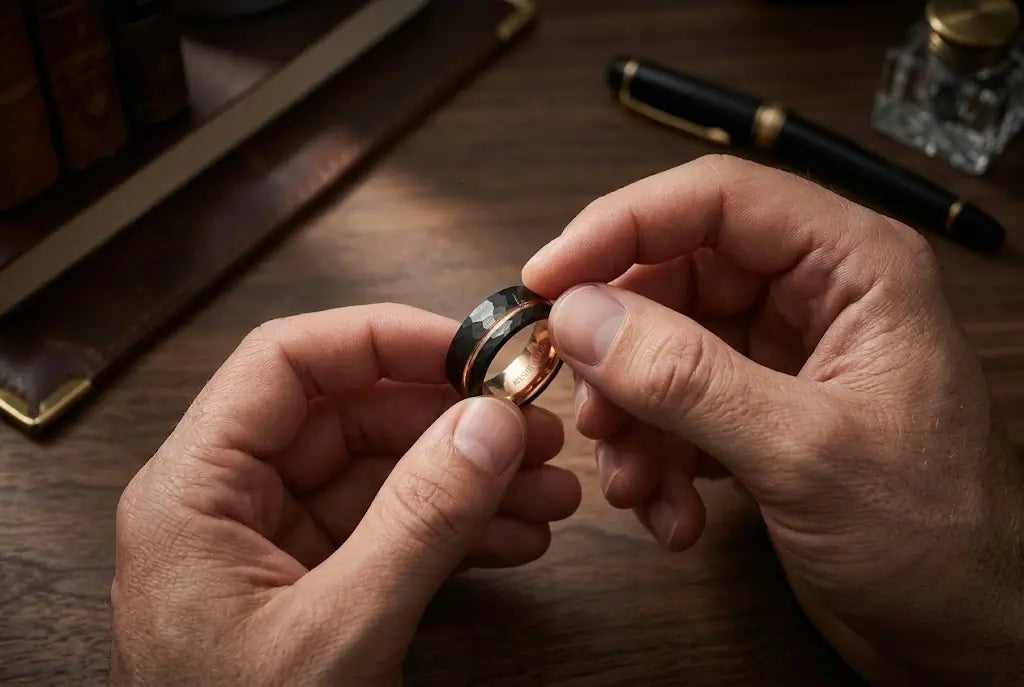
Choosing a wedding band is one of the few decisions you’ll make for your wedding that truly lasts a lifetime. Unlike the flowers or the menu, this band will be with you through every gym session, every day at the office, and every weekend adventure.
In 2026, the jewelry market is facing a unique moment. With international spot gold prices reaching record highs—frequently hovering around $4,700 per ounce and peaking earlier this year near $5,600—the choice between 14k and 18k gold is no longer just about aesthetics. It is a strategic balance of durability, skin health, and long-term value.
At Archer Wade, we believe in "real-world wear." We don’t just look at how a ring shines in a display case; we look at how it holds up after a year on your hand.

The Technical Foundation: Purity and Composition
To understand the difference between 14k and 18k, we have to look at the "Karat" system. Pure gold (24k) is surprisingly soft—almost like lead. To make it functional for a men's wedding band, jewelers mix it with other metals to create an "alloy."
-
14k Gold: Composed of 14 parts gold and 10 parts alloy metals. Mathematically, it is 58.3% pure gold. The remaining 41.7% consists of metals like copper, silver, and zinc.
-
18k Gold: Composed of 18 parts gold and 6 parts alloy, resulting in 75% pure gold. It is more "precious" by volume but contains fewer strengthening metals.
The Archer Wade Take: Think of 14k as the "Workhorse" and 18k as the "Heritage" metal. Both are genuine gold, but they serve different daily demands.
Durability: The Vickers Hardness Reality
One of the most common myths is that "more gold is always better." In terms of daily survival, the opposite is often true. We measure metal hardness using the Vickers Scale (HV). A higher number means the metal is more resistant to scratches and dents.
Vickers Hardness Comparison (2026 Industry Data)
|
Metal Type |
Vickers Hardness (HV) |
Durability Profile |
|
14k Yellow Gold |
140 – 160 HV |
High resistance to daily "knocks." |
|
18k Yellow Gold |
125 – 155 HV |
Softer; prone to a "soft patina" over time. |
|
14k White Gold |
~230 HV |
Extremely hard; resists deep scratches. |
|
18k White Gold |
~210 HV |
Slightly softer but still very resilient. |
If you work with your hands, hit the squat rack, or spend your weekends outdoors, 14k gold offers a clear structural advantage. While 18k gold won’t fail, it will "record" the story of your life much faster in the form of fine scratches and nicks.

The "Eye Test": Color and 2026 Aesthetic Trends
While durability is a science, color is an art. The higher gold content in 18k changes the way light interacts with the metal.
Yellow Gold
18k yellow gold has a rich, buttery, and saturated hue. It looks "vivid." In contrast, 14k yellow gold is more muted—think of a "champagne" or straw-colored yellow. In 2026, we are seeing a trend toward 4mm Slim-Classic bands. Because these bands are thinner, many men choose 18k to ensure the gold color remains prominent and rich.
White Gold and the "Warm-Back" Effect
Both 14k and 18k white gold are typically finished with a Rhodium plating for a brilliant, silvery shine. However, Rhodium wears off over time. When it does, 18k white gold reveals a warmer, yellowish undertone because of its high gold content. 14k white gold stays "whiter" underneath because it contains more white-alloy metals.
Health and Sensitivity: The Hypoallergenic Nuance
This is a critical "Your Money, Your Life" (YMYL) consideration. Nickel allergies affect roughly 8% to 19% of the population.
Because 18k gold is 75% pure, it naturally contains fewer base metals, making it generally more hypoallergenic. However, at Archer Wade, we advise a nuanced approach:
-
High Purity: 18k is the safer bet for most sensitive skin types.
-
Alloy Awareness: Even 18k can contain nickel if not specified. Always look for "Nickel-Free" certifications if you have a known allergy, regardless of the Karat.
Financial Value in 2026: Investment vs. Utility
With gold prices at all-time highs, the price gap has become a significant factor for modern couples. Currently, an 18k band typically carries a 20% to 30% price premium over 14k.
-
14k Value: You are paying for the craftsmanship and the utility. It is an "Everyday Carry" (EDC) item that happens to be precious metal.
-
18k Value: You are paying for the "melt value" and the prestige. It holds more intrinsic commodity value should gold prices continue their upward 2026 trajectory.
The Archer Wade Guide: How to Choose
We believe in making decisions based on how you actually live.
-
Choose 14k Gold if: You have a high-impact job, want a "set it and forget it" ring, or prefer a lighter, more understated yellow gold tone.
-
Choose 18k Gold if: You have sensitive skin, love the deep, vivid glow of high-purity gold, or want a heavy, "heritage" feel on your finger.

Conversational FAQs
"Does 18k gold scratch just from typing?"
Not usually from typing, but it is susceptible to "micro-marring" from harder surfaces like granite countertops or gym equipment. Over time, it develops a soft, matte patina that many find more "soulful" than a mirror finish.
"Can I resize these bands later?"
Yes. Both are highly "workable." However, 18k is slightly more malleable, making it a bit easier for a jeweler to adjust without risking stress fractures in the metal.
"What is the best width for a man's band right now?"
In 2026, the trend has shifted toward 4mm and 6mm "Comfort Fit" profiles. They are less intrusive for daily tasks and offer a more refined, modern look.
Conclusion: The Archer Wade Standard
Your wedding band is a reflection of your personal narrative. Whether you choose the rugged, dependable nature of 14k or the rich, storied prestige of 18k, the goal is to wear a piece that feels like an extension of yourself.
At Archer Wade, we specialize in the "Standard"—ensuring that every band, regardless of karat, is finished with the precision of a master craftsman. From our hand-brushed finishes to our premium unboxing experience, we make sure your choice feels as significant as the day you first wear it.